HomeScience & EnvironmentVaccine breakthrough for deadly...

Vaccine breakthrough for deadly elephant virus

Victoria GillScience correspondent, BBC News
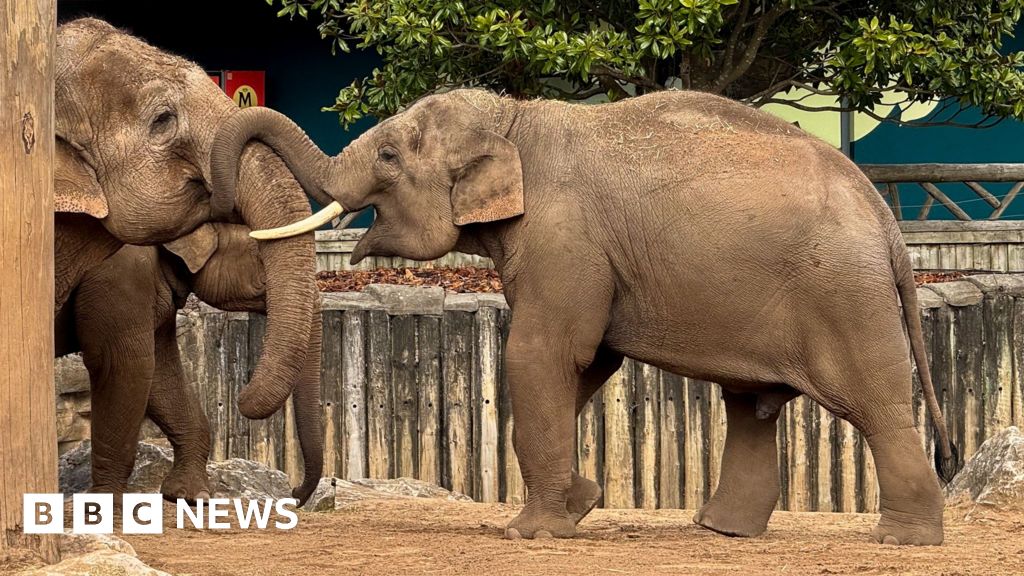
Victoria Gill/BBC A young male elephant, on the right of the image, face to face with an older, larger female. The animals are side-on to the camera and the younger male has his mouth open and his trunk looped around the older female's. Victoria Gill/BBC

Chester Zoo alone has lost seven baby elephants to disease caused by the virus

Researchers have made a breakthrough in the development of new vaccine to prevent a deadly virus that affects young elephants.

The vaccine, produced by an international research team, aims to prevent the severe disease caused by elephant endotheliotropic herpesvirus (EEHV), which is currently a leading cause of death in young Asian elephants.

In trials that involved adult elephants at Chester Zoo, the vaccine was found to be safe and, crucially, to activate part of the immune system that helps fight viruses.

Prof Falko Steinbach from the UK Animal and Plant Health Agency (APHA) and the University of Surrey, said this was “a landmark moment in our work to protect Asian elephants”.

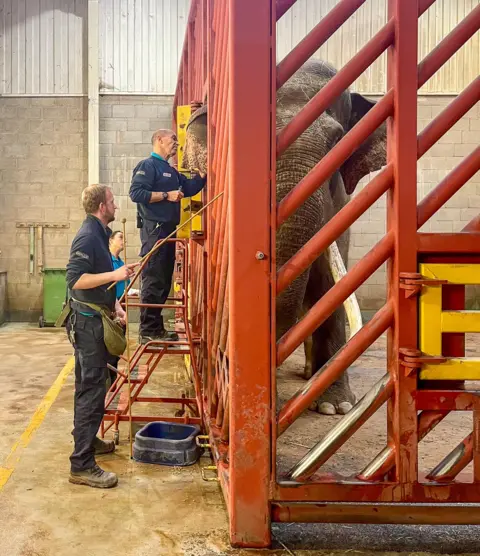
Victoria Gill/BBC A large, male elephant stands behind a red, barred fence, while a vet on the other side of the fence takes a blood sample from the elephant's ear. The elephant has been trained to present his ear to a door in the fence, so that the vet, who is standing on a step ladder in order to reach the height of the elephant's head, can access the animal.   Victoria Gill/BBC

The research involved the elephants at Chester Zoo

Kevin Church/BBC A female elephant - open-mouthed and photographed from the side - curls her trunk behind her head.  Kevin Church/BBC

The next step is to test the new vaccine in younger elephants

It is hoped that the result of this first-of-its-kind trial will pave the way to preventing the deaths of young elephants from the dangerous disease caused by this virus.

EEHV has had a particularly devastating impact in zoos. At Chester Zoo alone, seven baby elephants have died of it over the last decade. It has also been found in wild elephant herds and in some sanctuaries and elephant orphanages.

It causes a haemorrhagic disease – uncontrolled bleeding that can be fatal within 24 hours. It results in death in more than 80% of cases in juvenile elephants.

Why EEHV can be so dangerous is still unknown. Many adult elephants carry the virus – apparently with no negative impact on their health. But it is thought that young calves are particularly vulnerable when they are being weaned, and when the immune-boosting antibodies from the mother’s milk decline.

At this stage, a calf’s immune system is in a delicate balance and it can become overwhelmed. “It can cause really severe disease,” Dr Katie Edwards, lead conservation scientist at Chester Zoo told BBC News.

“It does affect wild elephants, but we don’t have an exact number of how many deaths in total it has caused. For elephants in human care [in zoos and sanctuaries] though, there have been more than 100 deaths.”
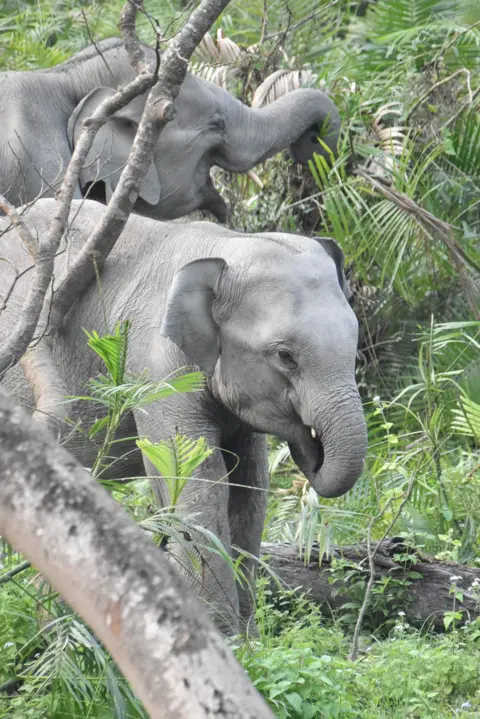
Falko Steinbach/APHA Two wild Asian elephants, in a lush green forest, feed on leaves.  Falko Steinbach/APHA

The researchers hope the vaccine will ultimately be used to protect elephants in their native habitat

The research team, led by veterinary scientists at the University of Surrey and the APHA, developed the new vaccine using a tried and tested “scaffold”. Essentially, the basic structure of this vaccine is identical to one routinely used to immunise elephants against a virus called cowpox.

The scientists seeded this vaccine structure with proteins from EEHV – non-infectious bits of the virus that the elephant’s immune system might recognise and respond to.

In a world-first trial, the team tested the new vaccine in three healthy, adult elephants at Chester Zoo, then analysed blood samples from the innoculated animals.

Prof Steinbach told BBC News that the results, published in the journal Nature Communications were “better than we had hoped for”.

“They showed, unequivocally that the vaccine was able to stimulate the production of [immune cells called] T cells, that are crucial to fighting viral infections.”

The next step for the scientists is to test the vaccine in younger elephants, which are the animals most vulnerable to severe disease.

The current vaccination requires four injections to be given, so another aim is to work out if the same protective dose can be given in a simpler way – perhaps with fewer jabs.

Dr Edwards explained: “Ultimately we want to use this vaccine in the elephants that are at risk, so we want to make sure that we can get it to where it’s needed.”

Prof Steinbach added: “We think this is a significant step forward, and not necessarily only for the elephants, but because it also shows that you can design and apply vaccines to help endangered species.”
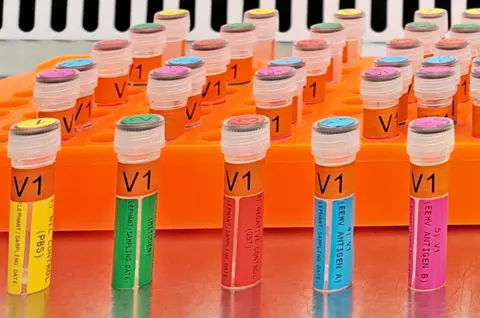
Falko Steinbach/University of Surrey A row of brightly coloured vials - labelled EEHV antigen - are lined up on a laboratory bench. This is one of the key ingredients in the newly developed vaccine that scientists hope will save elephants' livesFalko Steinbach/University of Surrey

The aim is to develop a vaccine that can be transported and stored where it is needed

Source link

- A word from our sponsors -

spot_img

Most Popular

More from Author

- A word from our sponsors -

spot_img

Read Now

is there someone out there exactly right for you?

Across history, humans have always been drawn to the idea that love isn't random. In ancient Greece, Plato imagined that we were once whole beings with four arms, four legs and two faces, so radiant that Zeus split us in two; ever since, each half has roamed...

Bengaluru CA explains why she quit her Rs 28 LPA job for ‘unstable income’ freelance career | Personal Finance News

New Delhi: Job security and worrying about job is a natural thought that keeps crossing the minds of salaried individuals. While, on one hand several people have posted about the difficult times being faced by them in their respective carriers on account of job loss, a Chartered...

Valentine’s Day romance scams target widowed, divorced Americans in 2026

NEWYou can now listen to Fox News articles! Valentine's Day should be about connection. However, every February also becomes the busiest season of the year for romance scammers. In 2026, that risk is higher than ever.These scams are no longer simple "lonely hearts" schemes. Instead,...

Chappell Roan leaves Wasserman talent agency after his mentions in Epstein files

Chappell Roan announced Monday that she's left her talent agency after its CEO was named in files related to late convicted sex offender Jeffrey Epstein released by...

Social media ads for prescription-only weight-loss medicines banned

Your support helps us to tell the storyFrom reproductive rights to climate change to Big Tech, The Independent is on the ground when the story is developing. Whether it's investigating the financials of Elon Musk's pro-Trump PAC or producing our latest documentary, 'The A Word', which shines...

A pulmonary embolism tied to colorectal cancer killed Catherine O’Hara. Here’s how common the event is among cancer patients

Your support helps us to tell the storyFrom reproductive rights to climate change to Big Tech, The Independent is on the ground when the story is developing. Whether it's investigating the financials of Elon Musk's pro-Trump PAC or producing our latest documentary, 'The A Word', which shines...

Nucleus Genomics CEO explains how “genetic optimization” tools help parents select traits they desire in babies

Big leaps in science have made a once-impossible, much-debated question come to life: Would you design your unborn child?Kian Sadeghi, the 25-year-old founder and CEO at Nucleus Genomics, believes every parent has a right to do just that, selecting qualities they desire –...

Jake Paul cries as fiancée Jutta Leerdam breaks an Olympic record

Jake Paul’s Dutch fiancee Jutta Leerdam won Olympic gold on Monday in speed skating. She broke the Olympic record...

US and Bangladesh strike new trade deal — key terms of the agreement

The United States and Bangladesh on Monday finalised the United States–Bangladesh Agreement on Reciprocal Trade, wrapping up negotiations as both countries stepped in to strengthen bilateral economic ties. Under the revised framework, Bangladeshi exports to the American market will attract a 19% tariff, marginally lower...