HomeScience & EnvironmentThe century-old ship sail...

The century-old ship sail technology finally catching on

Kevin KeaneEnvironment, energy and rural affairs correspondent, BBC Scotland
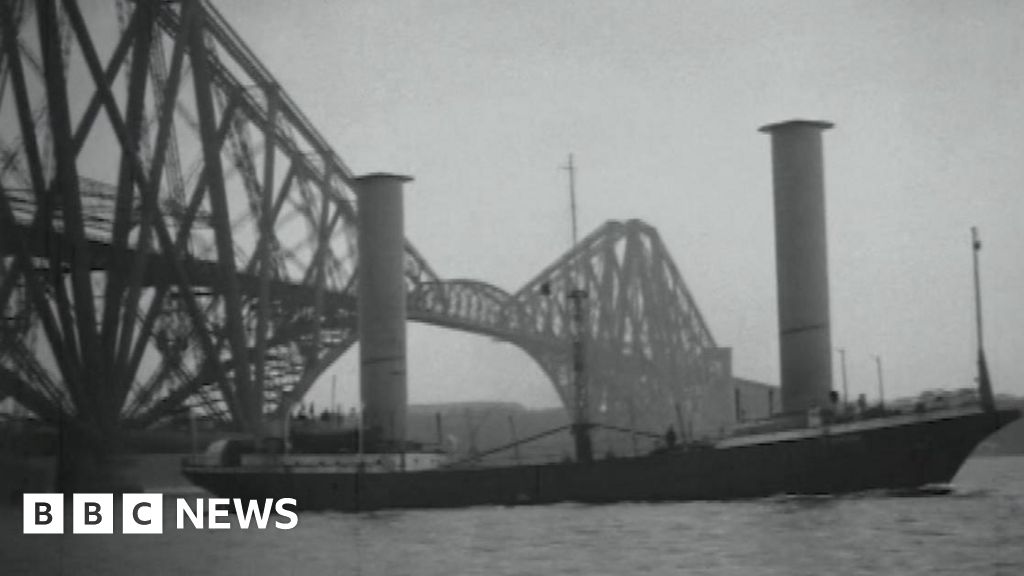
Pathe News Black and white image of the Buckau, with a black hull and two large towers sticking up from the deck.  It has just passed under the iconic Forth BridgePathe News

The twin Flettner rotor ship Buckau made its maiden voyage into Grangemouth in 1925

It must have been a bizarre sight when a freight ship, equipped with two large rotating towers, made its way under the Forth Bridge a century ago.

The experimental sail technology, on the rotor ship Buckau, was first demonstrated in 1925 on a journey carrying timber from Danzig – now Gdansk, in Poland – to the Scottish port of Grangemouth.

The spinning towers were designed to harness the wind as a way of saving fuel but it didn’t catch on for about 90 years.

Now the pioneering Flettner rotors are being used on at least 35 commercial freight ships to improve fuel efficiency and reduce their impact on the climate.

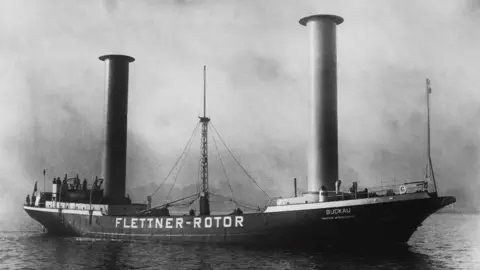
Hulton Deutsch/Getty Images Black and white photo showing the Buckau with its two modified rotating towers and a mast in the middle. It now contains the words "Flettner-Rotor" on the sides.Hulton Deutsch/Getty Images

After her maiden voyage from Poland to Scotland, Buckau crossed the Atlantic to the US

The original ship was modified to incorporate the tall spinning towers, which were powered by motors, as a way of saving money on fuel costs.

Experts say the relatively low cost of fossil fuels, like diesel, meant it was unlikely the shipping lines of the 1920s would make back the investment required to install them.

The Great Depression of 1929 was the final nail in the coffin for the design, with orders being cancelled by ship owners.

But modern-day decarbonisation targets mean technologies which can improve fuel efficiency, like this one, are becoming more highly prized in the maritime sector.
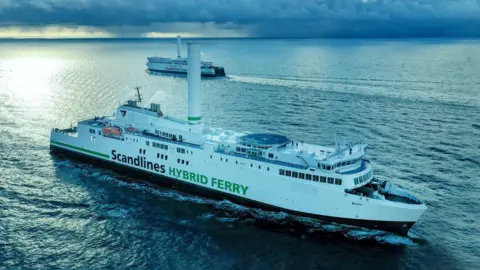
Norsepower Two large, white ferries are seen passing each other in open seas.  On the decks is a helideck and a single large rotating tower.Norsepower

Single rotors have been installed on two ferries between Germany and Denmark

The technology, known as Flettner rotors, were designed by aeronautical engineers led by the German inventor Anton Flettner.

The towers are powered by motors which effectively redirect the wind to generate forward thrust.

It’s called the Magnus effect and is the same principle which causes a spinning football to bend through the air – especially when kicked by David Beckham.

Operators say it can cut fuel bills by up to 20% as well as reducing planet warming greenhouse gas emissions from burning diesel.
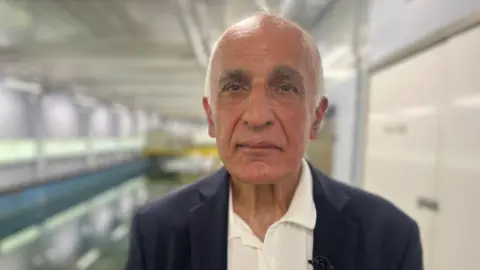
BBC News A man in a white shirt and dark jacket with some white hair in front of a long pool used for testing shipping technology.BBC News

Prof Mehmet Atlar says the technology in use today is the same as in 1925

Modern rotors are even more efficient than the ones on Buckau in 1925 because they are made with lighter composite materials such as carbon fibre.

Prof Mehmet Atlar, an expert in hydrodynamics at Strathclyde University, believes there was a lot of initial interest in the design with an order book starting to grow.

A larger ship was launched, called the Barbara, with a further six waiting to be built.

But by the end of the 1920s, those orders were being cancelled and the design concept was shelved.

He said: “In my opinion, nothing is new.

“The need is the most important thing. The need now is there, therefore the Flettner rotor came back.”

He said that the lighter materials, combined with more effective motors to drive the rotors, mean it’s much more effective than a century ago.

‘Sustainable solution’

The Finnish company Norsepower revived the design when it began exploring fuel efficiency systems for ships more than a decade ago.

It has since built 35 sails, mostly retrofitted, with orders for a further 48.

The company said some ships were even being built “rotor ready”.

Chief executive Heikki Pöntynen said: “I would say that this will become a very common sight.

“We can see the market booming and developing very fast.”

He added the lighter materials were important.

But Mr Pöntynen said the use of artificial intelligence, to drive the positioning of the “sails” against the direction of the wind, made it most effective.

He also said the Flettner rotor was a “really sustainable solution” for decarbonising shipping.

The technology can be added to any ship so long as there is sufficient deck space.

That makes it ideal for freight carriers and tankers.

However, Mr Pöntynen added that it would be difficult fitting the rotors to container ships which use every available space.


Source link

- A word from our sponsors -

spot_img

Most Popular

More from Author

- A word from our sponsors -

spot_img

Read Now

Bengaluru CA explains why she quit her Rs 28 LPA job for ‘unstable income’ freelance career | Personal Finance News

New Delhi: Job security and worrying about job is a natural thought that keeps crossing the minds of salaried individuals. While, on one hand several people have posted about the difficult times being faced by them in their respective carriers on account of job loss, a Chartered...

Valentine’s Day romance scams target widowed, divorced Americans in 2026

NEWYou can now listen to Fox News articles! Valentine's Day should be about connection. However, every February also becomes the busiest season of the year for romance scammers. In 2026, that risk is higher than ever.These scams are no longer simple "lonely hearts" schemes. Instead,...

Chappell Roan leaves Wasserman talent agency after his mentions in Epstein files

Chappell Roan announced Monday that she's left her talent agency after its CEO was named in files related to late convicted sex offender Jeffrey Epstein released by...

Social media ads for prescription-only weight-loss medicines banned

Your support helps us to tell the storyFrom reproductive rights to climate change to Big Tech, The Independent is on the ground when the story is developing. Whether it's investigating the financials of Elon Musk's pro-Trump PAC or producing our latest documentary, 'The A Word', which shines...

A pulmonary embolism tied to colorectal cancer killed Catherine O’Hara. Here’s how common the event is among cancer patients

Your support helps us to tell the storyFrom reproductive rights to climate change to Big Tech, The Independent is on the ground when the story is developing. Whether it's investigating the financials of Elon Musk's pro-Trump PAC or producing our latest documentary, 'The A Word', which shines...

Nucleus Genomics CEO explains how “genetic optimization” tools help parents select traits they desire in babies

Big leaps in science have made a once-impossible, much-debated question come to life: Would you design your unborn child?Kian Sadeghi, the 25-year-old founder and CEO at Nucleus Genomics, believes every parent has a right to do just that, selecting qualities they desire –...

Jake Paul cries as fiancée Jutta Leerdam breaks an Olympic record

Jake Paul’s Dutch fiancee Jutta Leerdam won Olympic gold on Monday in speed skating. She broke the Olympic record...

US and Bangladesh strike new trade deal — key terms of the agreement

The United States and Bangladesh on Monday finalised the United States–Bangladesh Agreement on Reciprocal Trade, wrapping up negotiations as both countries stepped in to strengthen bilateral economic ties. Under the revised framework, Bangladeshi exports to the American market will attract a 19% tariff, marginally lower...

Parenting quote of the day: “Parents can only give good advice or put them on the right paths, but the final forming of a...

Anne Frank's insights remind us that, although parental guidance is crucial, a child's true character develops through their own experiences. Trusting them to learn from real - life consequences and instilling values they can internalize are vital. Genuine maturity is born in quiet moments of decision-making,...