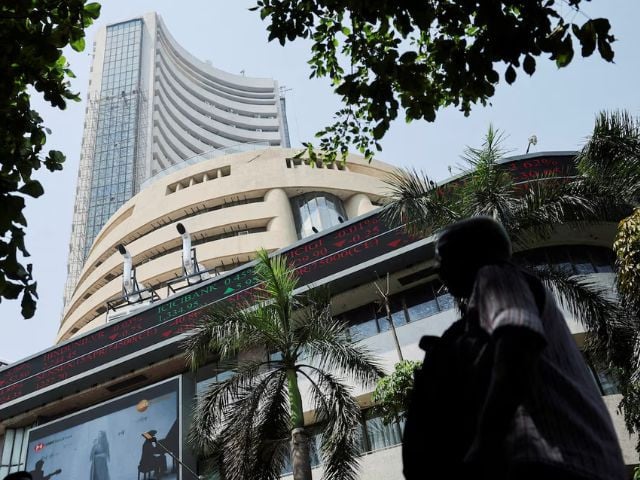
Indian stock markets lost an estimated $83 billion in market capitalisation this week as escalating military conflict with Pakistan triggered investor concerns and rattled financial markets.
The sell-off deepened after Pakistan launched a retaliatory military operation, Operation Bunyan-un-Marsoos, targeting strategic Indian installations in response to missile strikes by New Delhi earlier in the week.
The Nifty 50 index fell 1.1% on Friday, closing just above the key 24,000-point psychological level. The BSE Sensex also declined 1.1%, finishing below the 80,000 mark it held a day earlier.
The two benchmark indexes have now posted a weekly loss of approximately 1.3%, ending a three-week rally — their longest winning streak of 2025.
At one point during Friday’s trading session, total market losses approached $108 billion before partial recovery late in the day.
“With so much escalation, domestic markets are jittery because further retaliatory measures from Pakistan could lead to a prolonged, full-fledged conflict,” said Avinash Gorakshaka, head of research at Profitmart Securities.
Analysts noted that market fundamentals had taken a back seat, with sentiment now largely driven by geopolitical updates. India’s volatility index, known locally as the “fear gauge”, rose for the eighth straight session, reaching a high not seen in over a month.
Twelve of the 13 major sectoral indexes ended the week in the red. Small-cap and mid-cap stocks fared worse than blue chips, with losses of 1.9% and 0.8% respectively.
The Indian rupee also faced pressure, prompting the central bank to step in to stabilise the currency in currency markets.
The one notable bright spot was in the auto sector. Shares of Tata Motors surged 8.7% on expectations that a potential UK-US trade deal could bolster sales for its British subsidiary, Jaguar Land Rover (JLR).
The company was the top gainer among the Nifty 50 constituents this week.
Despite ongoing tensions, analysts say optimism over a possible US-India trade deal and India’s resilient economic fundamentals could help limit long-term market damage if diplomatic efforts succeed in easing hostilities.
Simmering tensions
Tensions between India and Pakistan escalated sharply following the April 22 attack in Pahalgam, located in Indian Illegally Occupied Jammu and Kashmir (IIOJK), which left 26 people dead. India blamed Pakistan-based elements for the attack without presenting evidence. Islamabad categorically rejected the accusations.
In response, India closed the Wagah land border, revoked Pakistani visas, and announced the suspension of the Indus Waters Treaty on April 23. Pakistan labelled any disruption to the treaty as an “act of war” and subsequently sealed the Wagah crossing on its side.
The situation further deteriorated on May 6 and 7, with explosions reported in several Pakistani cities including Muzaffarabad, Kotli, Muridke, and Bahawalpur. Pakistan’s military spokesperson, Lieutenant General Ahmed Sharif Chaudhry, confirmed that Indian airstrikes had targeted multiple locations. Pakistan responded with air and ground operations under a new military campaign named Operation Bunyan-un-Marsoos.
Within the first hour of retaliation, Pakistan claimed to have downed five Indian fighter jets, including four Rafale aircraft. Lt Gen Chaudhry stated that Pakistan had the capability to down more but exercised restraint. Indian media provided limited coverage, with one report by The Hindu later retracted.
International observers, including analysts on CNN, noted the downing of Rafale jets has challenged India’s narrative of regional air superiority. A senior French intelligence official also confirmed the loss of one Rafale aircraft to CNN—the first combat loss for the jet.
In addition, Pakistan’s armed forces reported intercepting and neutralising 77 Israeli-made Harop drones allegedly launched by India. According to the Inter-Services Public Relations (ISPR), the drones were brought down using a mix of electronic warfare and conventional air defence systems. ISPR described the drone activity as a “desperate and panicked response” to Pakistan’s defence strikes.
Security sources confirmed that Operation Bunyan-un-Marsoos is targeting bases identified as launch points for attacks on civilians and mosques. Pakistan also launched its Al-Fatah missile as part of the operation, in honour of children killed during recent Indian attacks.