Scientists are homing in on the nature of a mysterious force called dark energy, and nothing short of the fate of the universe hangs in the balance.
The force is enormous — it makes up nearly 70% of the universe. And it is powerful — it is pushing all the stars and galaxies away from each other at an ever faster rate.
And now scientists are getting a little closer to understanding how it behaves. The big question is whether this dark energy is a constant force, an idea first introduced by Albert Einstein in his theory of relativity, or whether the force is weakening, a surprising wrinkle tentatively proposed last year.
Results presented at a meeting of the American Physical Society Wednesday bolster the case that the force is weakening, though scientists are not yet certain and they still haven’t worked out what this means for the rest of their understanding of the universe.
The updated findings come from an international research collaboration that is creating a three-dimensional map to see how galaxies have spread and clustered over 11 billion years of the universe’s history. Carefully tracking how galaxies move helps scientists learn about the forces that are moving them around.
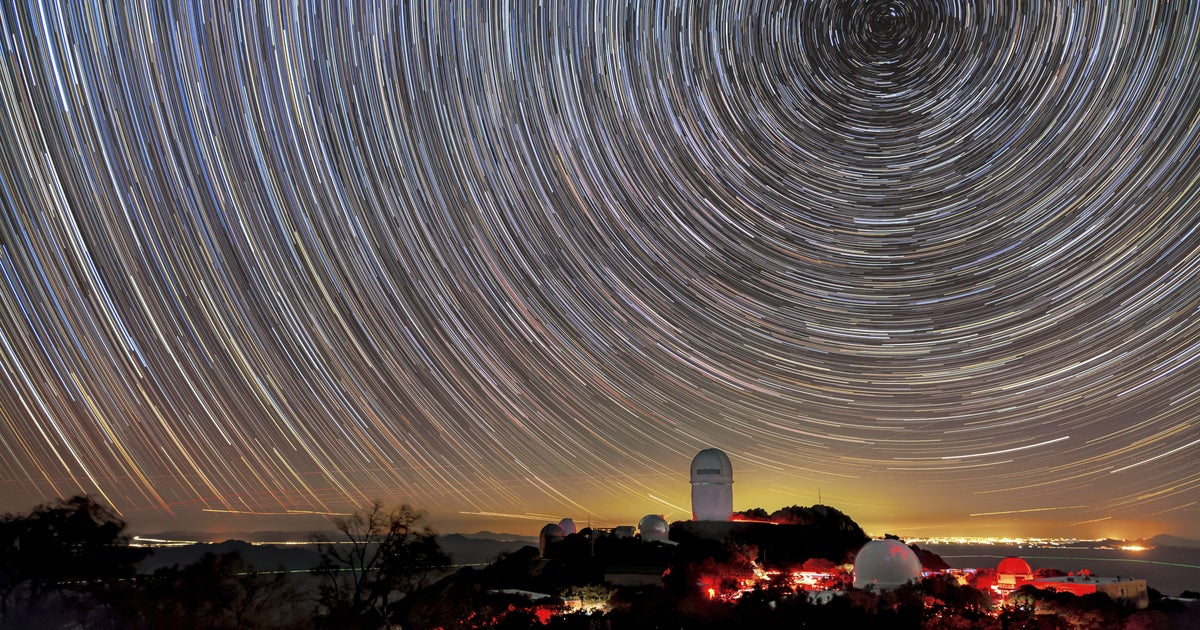
Called the Dark Energy Spectroscopic Instrument (DESI), the collaboration released its first analysis of 6 million galaxies and quasars last year and has now added more data, bringing the count to nearly 15 million. Their updated results, taken with other measurements — exploding stars, leftover light from the young universe and distortions in galaxy shape — support the idea presented last year that dark energy may be waning.
NSF’s NoirLab via AP
“It’s moving from a really surprising finding to almost a moment where we have to throw out how we’ve thought about cosmology and start over,” said Bhuvnesh Jain, a cosmologist with the University of Pennsylvania who was not involved with the research.
Alexie Leauthaud-Harnett, a spokesperson for the DESI collaboration, called the new observations “deeply intriguing.”
“It is exciting to think that we may be on the cusp of a major discovery about dark energy and the fundamental nature of our universe,” she said in a statement.
It’s not time to completely rule out the idea that dark energy is constant because the new results are still shy of the gold standard level of statistical proof physics requires. The collaboration aims to map around 50 million galaxies and quasars by the end of its survey in 2026.
“We want to see several different collaborations having similar measurements” at that gold standard to be sure that dark energy is weakening, said cosmologist Kris Pardo with the University of Southern California who was not involved with the new research.
The “Big Crunch”
If dark energy is constant, scientists say our universe may continue to expand forever, growing ever colder, lonelier and still.
If dark energy ebbs with time, which now seems plausible, the universe could one day stop expanding and then eventually collapse on itself in what’s called the “Big Crunch.” It might not seem like the cheeriest fate, but it offers some closure, said cosmologist and study collaborator Mustapha Ishak-Boushaki of the University of Texas at Dallas.
“Now, there is the possibility that everything comes to an end,” he said. “Would we consider that a good or bad thing? I don’t know.”
Other efforts around the globe have an eye on dark energy and aim to release their own data in the coming years, including the European Space Agency’s Euclid mission and the Vera C. Rubin Observatory in Chile.
Launched in 2023, the ESA’s $1.5 billion Euclid space telescope is equipped with a near-perfect 3-feet 11-inch-wide primary mirror and two instruments: a 600 megapixel visible light camera and a 64-megapixel infrared imaging spectrometer. The telescope’s field of view is roughly twice the size of the full moon.
It will take Euclid six years to complete its map of the sky, generating on the order of 100 gigabytes of compressed data per day, or an estimated, difficult-to-imagine 70,000 terabytes over the course of the mission.
William Harwood
contributed to this report.



, which sits on a telescope at the Kitt Peak National Observatory in Arizona.)