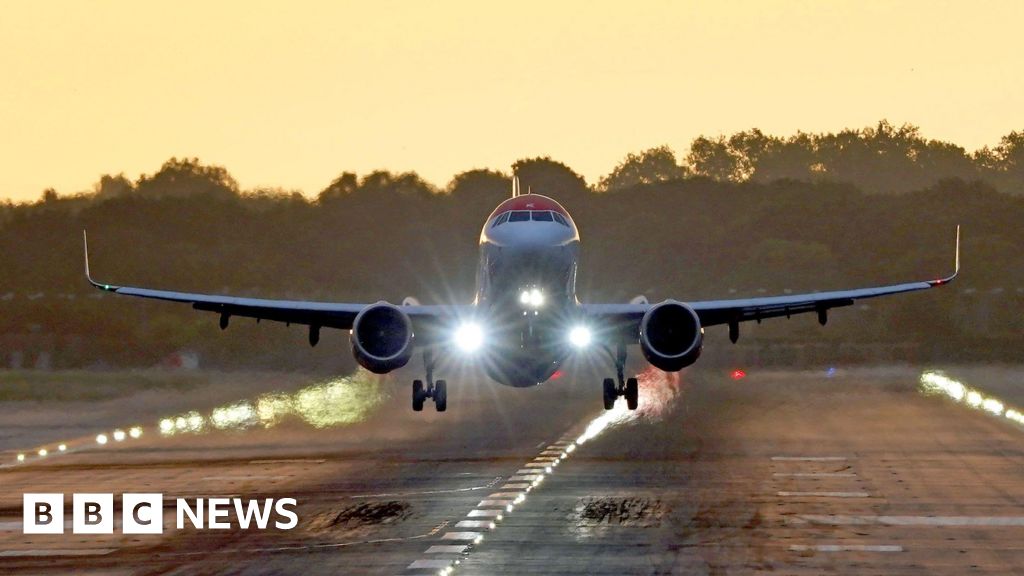
Plans for a second runway at Gatwick have been approved by the government, making it the latest in a string of planned UK airport expansions to receive support.
The Gatwick decision could lead to an extra 100,000 flights per year. If Heathrow gets permission to build a third runway – which the government has said it backs – that could mean another 276,000 flights a year, with approval for an expansion of Luton airport also potentially adding tens of thousands.
If such large expansions are to take place while meeting the target of becoming net zero by 2050, big reductions in aircraft emissions will be needed.
Some cuts can be made in relatively simple ways – for example, by replacing old aircraft with new ones.
A current-generation Airbus A320neo is 15-20% more fuel efficient than its predecessor, for example. If you use less fuel, you produce fewer emissions.
However, this on its own will not go nearly far enough.
In its latest progress report to Parliament, the UK’s climate watchdog, the UK Climate Change Committee (UKCCC), has warned emissions from flying “pose a risk to the UK’s emissions targets”.
Last year, emissions from flying saw an increase of 9%, which the UKCCC has put down to an increasing demand for international leisure flights – holidays abroad – which is Gatwick’s main type of flight.
Although the UKCCC did not rule out airport expansion altogether – it did caution that the government should look at measures to reduce demand for flights.
The UK has legally binding targets to reduce its levels of planet-warming emissions, and contribute to the global goal of preventing average temperatures rising by more than 1.5C by 2050.
Above this temperature level, scientists anticipate significant impacts from global sea level rise, more extreme weather and impacts on agriculture.
To prevent temperatures increasing there is a limit to the amount of greenhouse gases, such as CO2, that the world can release, and the UK has set out its own share of these – known as carbon budgets.
In 2021, for the first time, the government agreed that its carbon budgets for 2033 onwards should include the country’s share of international flying and shipping. That means decisions to expand airports could have a significant impact on the country’s climate targets.
That means a great deal is being expected from “sustainable aviation fuels” or SAF over the coming decades.
These are fuels which can be produced from waste oils, from feedstocks such as wood, crops and agricultural waste, or synthesised from captured carbon dioxide and water.
Such fuels can result in much lower emissions than fossil fuels when burnt, because they do not release long-stored CO2 into the atmosphere.
However, in practice their environmental benefits can vary dramatically depending on what they are made from and how they are manufactured.
In addition, there is not currently a lot of SAF around – and what there is, can be very expensive.
The government is attempting to build a greater market for sustainable fuels in the hope this will stimulate production and bring down prices.
There is currently a SAF mandate, which stipulates that 2% of all jet fuel supplied in the UK this year must be considered sustainable, rising to 10% by 2030 and 22% by 2040.
In addition, a bill currently before Parliament would set up a “revenue certainty mechanism” for SAF producers – in effect guaranteeing them a minimum price for the fuel they provide.
In theory, this should encourage more investment in SAF production.
However, it would be funded through a levy on fuel suppliers, who would be likely to pass on the extra costs to their customers. That could ultimately mean higher ticket prices for passengers.
In the longer term, more radical solutions may become available, such as aircraft powered by hydrogen.
However, that will require a step-change in aircraft design, as well as big changes at airports. It will also require a supply of affordable “green” hydrogen, produced from renewable energy – and the infrastructure for that does not yet exist.
Electric or hybrid planes could have environmental benefits, but again the technology is in its early stages – and battery-powered planes are not currently thought to be a viable option for long-haul flights.